

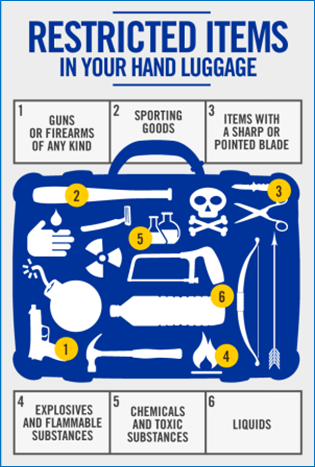
For security reasons, certain objects are forbidden in hand luggage:
- Guns, firearms and other devices that discharge projectiles: devices capable, or appearing capable, of being used to cause serious injury by discharging a projectile;
- Neutralizing devices: devices designed specifically to stun or immobilize;
- Sharp objects: objects, due to their sharp tip or sharp edges, can be used to cause serious injuries;
- Working tools: tools that can be used to cause serious injury or threaten the safety of the aircraft;
- Blunt instruments: objects that can cause serious injury if used to harm someone physically;
- Explosives and incendiary substances and devices: materials and explosives or incendiary devices capable, or appearing capable, of being used to cause serious injury or threaten the safety of the aircraft;
- Liquids, Aerosols and Gels.
Note: Carrying liquids on board is authorized only in containers with a capacity of up to 100 millilitres and not more than one litre in total per passenger.
An electronic cigarette or e-cigarette is an electronic device that is designed to simulate the act of smoking.
It can appear similar to a normal cigarette both in the way it looks and how it works and it can even simulate smoke, although this "smoke" is really vapour.
The devices usually have three elements in common:
- mouthpiece (cartridge)
- heating element (atomising chamber)
- battery (usually a rechargeable lithium ion battery and an electronic LED system that emits colored light).
Although electronic cigarettes are not prohibited by law, their use on board the aircraft may cause problems. For this reason, their use is not allowed on board MAI aircraft. They can, however, be transported in the hand luggage.
Electronic devices may cause interference with the navigation or communication systems of the aircraft on which they are used. PEDs should not be used during takeoff and landing and should be properly stowed, similarly to other carry-on luggage.
To avoid the risk of interference, the operation of the following electronic devices is restricted as follows:
1. Devices that can be used at any time - unrestricted use:
- Devices powered by micro battery cells;
- Devices powered by solar cells;
- Electric watches;
- Hearing aids (including digital devices);
- Pagers (only receivers);
- Heart pacemakers;
- Other similar types of equipment.
2. Devices limited to use on the ground - restricted use, associated with door position:
- Mobile phones;
The use of mobile phones is not allowed on board the aircraft except when it is parked and at least one door is open.
Senior cabin crew will announce the prohibition on continuing to use mobile phones as soon as the doors are closed.
3. Devices limited to use in cruise flight - restricted use, associated with the aircraft portable electronic device sign:
- Mobile phones in light mode;
- Laptops with CD ROM or DVD drives;
- Palmtop organizers;
- Handheld calculators without printers;
- Portable audio equipment (walkman, CDP-player, mini disc-player, MP3-player);
- Video cameras and recorders (also digital);
- Display units (except cathode ray tubes);
- GPS handheld receivers;
- Electric shavers;
- Electronic toys (excluding remote controlled);
- Other similar types of equipment.
Note: PEDs are allowed to be used in flight mode or equivalent profile, such as Flight Safe Mode, offline or radio wave OFF mode.
4. Devices forbidden to be used on the aircraft - prohibited use:
- Devices transmitting RF intentionally;
- Walkie-talkies;
- Remote controlled toys;
- Display units with cathode-ray tubes;
- Wireless computer equipment (mouse);
- PC-printers;
- CD-writers and MiniDisc recorders in recording mode;
- Big portable stereo sets;
- Pocket radios (AM/FM);
- TV receivers;
- Telemetric equipment;
- Bluetooth devices;
- Other similar types of equipment.
5. Devices where a single-case decision must be obtained from the relevant engineering organization: (Condition: the device is required to conduct the intended flight).
- Airborne videoconference installations;
- Special cargo utility equipment;
- All devices that cannot be clearly categorized in the categories above.
The list above gives examples of typical devices inside a category. The senior cabin crew must inform the commander in case a passenger is using one of these electronic devices.
The commander may prohibit the use of electronic devices of any category during any phase of flight, if required in the interest of safety.