

For your safety, international regulatory authorities have imposed certain restrictions or prohibitions on the carriage of dangerous goods.
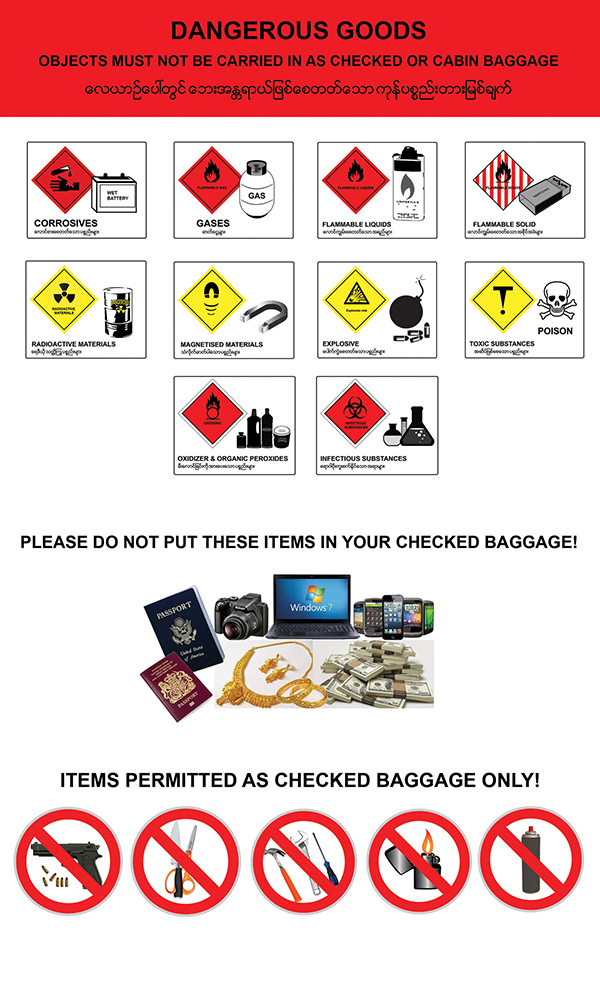
Important: Local airport security restrictions may further limit the quantities & conditions of carriage specified below. Passengers must ensure that they comply with all applicable restrictions before travelling.
Provisions for Dangerous Goods Carried by Passengers or Crew
Dangerous goods must not be carried by passengers or crew, either in checked baggage or carry-on baggage, except as otherwise provided below.
Dangerous goods permitted in carry-on baggage are also permitted on one's person, except where otherwise specified.
| Type of Dangerous Goods | Permitted in or as Carry-on Baggage | Permitted in or as Checked Baggage | The Approval of the operator is required | The pilot-in-command must be informed of the location |
|---|---|---|---|---|
|
Disabling devices such as mace, pepper spray, etc., containing an irritant or incapacitating substance are forbidden on the person & in checked or carry-on baggage. |
FORBIDDEN | |||
| Electroshock weapons (e.g., Tasers) containing dangerous goods such as explosives, compressed gases, lithium batteries, etc., are forbidden in carry-on baggage, checked baggage, or on the person. | FORBIDDEN | |||
|
Security-type attaché cases, cash boxes, cash bags, etc., incorporating dangerous goods such as lithium batteries and/or pyrotechnic material, are totally forbidden, except as provided in Ref: 6. (See Ref: 6 for details.) |
FORBIDDEN | |||
|
Ammunition (cartridges for weapons) |
FORBIDDEN | |||
|
Oxygen or air, gaseous, cylinders required for medical use are forbidden, except as provided in Ref: 4. (See Ref: 4 for details.) |
FORBIDDEN | |||
|
Baggage with installed batteries: Non-removable batteries exceeding 0.3 g of lithium metal or 2.7 Wh are forbidden. |
FORBIDDEN | |||
| Mobility Aids: Battery-powered wheelchairs or other similar mobility devices with non-spillable wet batteries, or with batteries that comply with Special Provisions A123 or A199, are permitted subject to the applicable requirements. (See Ref: 5 for details.) | NO | YES | YES | YES |
|
Mobility Aids: Battery-powered wheelchairs or other similar mobility devices with spillable batteries are subject to the applicable requirements. (See Ref: 2 for details). Battery-powered wheelchairs or other similar mobility devices with lithium batteries are subject to the applicable requirements. (See Ref: 3 for details). |
NO | YES | YES | YES |
| Mercury-filled thermometers or barometers carried by a representative of a government weather bureau or similar official agency (See Ref: 1 for details). | YES | NO | YES | YES |
|
Camping stoves & fuel containers that have contained a flammable liquid fuel, with an empty fuel tank and/or fuel container (See Ref: 7 for details). |
NO | YES | YES | NO |
| Security-type equipment containing lithium batteries (See Ref: 6 for details). | NO | YES | YES | NO |
|
Chemical Agent Monitoring Equipment when carried by staff members of the Organization for the Prohibition of Chemical Weapons on official travel (See Ref: 8 for details). |
YES | YES | YES | YES |
| Heat-producing articles such as underwater torches (diving lamps) and soldering irons (See Ref: 9 for details). | YES | YES | YES | NO |
| Avalanche rescue backpack: One (1) per person, containing a cylinder of compressed gas in Division 2.2. It may also be equipped with a pyrotechnic trigger mechanism containing no more than 200 mg net of Division 1.4.S. The backpack must be packed in such a manner that it cannot be accidentally activated. The airbags within the backpack must be fitted with pressure relief valves. | YES | YES | YES | NO |
|
Dry ice (Carbon dioxide, solid): In quantities not exceeding 2.5 kg per person when used to pack perishables that are not subject to these Regulations, in checked or carry-on baggage, provided that the baggage (package) permits the release of carbon dioxide gas. Checked baggage must be marked "Dry ice" or "Carbon dioxide, solid", with the net weight of the dry ice or an indication that there is 2.5 kg or less of dry ice. |
YES | YES | YES | NO |
|
Gas cartridges, small, non-flammable: Containing carbon dioxide or other suitable gas in Division 2.2. Up to two (2) small cartridges may be fitted into a self-inflating safety device, such as a life jacket or vest. Not more than one (1) device is permitted per passenger, with up to two (2) spare small cartridges per passenger. For other devices, not more than four (4) cartridges, each with a water capacity of up to 50 ml, are permitted (See Ref: 10 for details). |
YES | YES | YES | NO |
| Lithium batteries, spare/loose: With a Watt-hour rating exceeding 100 Wh but not exceeding 160 Wh for consumer electronic devices & PMED, or with a lithium content exceeding 2 g but not exceeding 8 g for PMED only. Only one (1) spare battery is permitted in carry-on baggage only. These batteries must be individually protected to prevent short circuits. (PMED = Portable Medical Electronic Devices.) | YES | NO | YES | NO |
|
Lithium battery-powered electronic devices: Lithium-ion batteries for portable electronic devices, including medical devices, with a Watt-hour (Wh) rating exceeding 100 Wh but not exceeding 160 Wh. For portable medical electronic devices only, lithium-metal batteries with a lithium content exceeding 2 g but not exceeding 8 g. (See Ref: 11 for details.) |
YES | NO | YES | NO |
| Alcoholic beverages: When in retail packaging, containing more than 24% but not more than 70% alcohol by volume, in receptacles not exceeding 5 L, with a total net quantity per person of 5 L. | YES | NO | YES | NO |
|
Non-radioactive medicinal or toilet articles (including aerosols), such as hair sprays, perfumes, colognes & medicines containing alcohol; and |
YES | YES | NO | NO |
|
Non-flammable, non-toxic aerosols in Division 2.2: With no subsidiary risk, for sporting or home use. The total net quantity of non-radioactive medicinal or toilet articles & non-flammable, non-toxic aerosols must not exceed 2 kg or 2 L & the net quantity of each single article must not exceed 0.5 kg or 0.5 L. Release valves on aerosols must be protected by a cap or other suitable means to prevent inadvertent release of the contents. |
YES | NO | YES | NO |
|
Electronic Cigarettes (including e-cigars, e-pipes & other personal vaporizers) containing batteries must be individually protected to prevent accidental activation. (See Ref: 18 for details.) |
YES | NO | NO | NO |
|
Fuel cells containing fuel & powering electronic devices (e.g., cameras, cellular phones, laptop computers & camcorders). (See Ref: 13 for details.) |
YES | NO | NO | NO |
| Fuel cell cartridges, spare: For portable electronic devices. (See Ref: 13 for details.) | YES | NO | NO | NO |
|
Hair curlers containing hydrocarbon gas: Up to one (1) per passenger or crew member, provided that the safety cover is securely fitted over the heating element. These hair curlers must not be used on board the aircraft at any time. Gas refills for such curlers are not permitted in checked or carry-on baggage. |
YES | YES | YES | NO |
|
Insulated packaging containing refrigerated liquid nitrogen (dry shipper): Fully absorbed in a material containing only non-dangerous goods. |
YES | YES | NO | NO |
|
Internal combustion or fuel cell engines: Must meet A70. (See Ref: 16 for details.) |
NO | YES | NO | |
| Thermometer, medical or clinical: Containing mercury, one (1) per person for personal use, when carried in its protective case. | NO | YES | NO | NO |
| Non-flammable, non-toxic gas cylinders: Worn for the operation of mechanical limbs. Spare cylinders of a similar size are also permitted if required to ensure an adequate supply for the duration of the journey. | YES | YES | NO | NO |
| Specimens, non-infectious: Packed with small quantities of flammable liquid. Must meet A180. (See Ref: 15 for details.) | YES | YES | NO | NO |
|
Permeation devices: Must meet A41. (See Ref: 17 for details.) |
YES | YES | NO | NO |
|
Baggage with installed lithium batteries:
|
YES | YES | NO | NO |
|
Lithium batteries - Portable electronic devices (PEDs) containing lithium metal cells or batteries, or lithium-ion cells or batteries: Including medical devices such as portable oxygen concentrators (POCs) & consumer electronics such as cameras, mobile phones & laptops, when carried by passengers or crew for personal use. (See Ref: 12 for details.) For lithium-metal batteries, the lithium-metal content must not exceed 2 g & for lithium-ion batteries, the Watt-hour rating must not exceed 100 Wh. Each person is limited to a maximum of 15 portable electronic devices (PEDs). Baggage equipped with a lithium battery, other than lithium button cells, must have a removable battery. If offered as checked baggage, the battery must be removed & carried in the cabin. |
YES | NO | NO | NO |
| Batteries, spare/loose, including lithium-metal or lithium-ion cells or batteries: For portable electronic devices, these must be carried in carry-on baggage only. For lithium-metal batteries, the lithium-metal content must not exceed 2 g, and for lithium-ion batteries, the Watt-hour rating must not exceed 100 Wh. Articles whose primary purpose is to serve as a power source, e.g., power banks, are considered spare batteries. These batteries must be individually protected to prevent short circuits. Each person is limited to a maximum of 20 spare batteries. | YES | NO | NO | NO |
|
Portable electronic devices containing non-spillable batteries: Batteries must meet A67 & must be 12 V or less & 100 Wh or less. A maximum of 2 spare batteries may be carried. (See Ref: 14 for details.) |
YES | YES | NO | NO |
|
Radioisotopic cardiac pacemakers or other devices, including those powered by lithium batteries, implanted into a person or fitted externally. |
ON ONE'S PERSON | NO | NO | |
|
Safety matches (one small packet) or a small cigarette lighter: Must not contain unabsorbed liquid fuel, other than liquefied gas & must be intended for use by an individual when carried on the person. Lighter fuel & lighter refills are not permitted on one's person or in checked or carry-on baggage. Note: "Strike anywhere" matches, "Blue flame" or "Cigar" lighters & lighters powered by a lithium battery without a safety cap or other means of protection against unintentional activation are forbidden. |
ON ONE'S PERSON | NO | NO | NO |
Note: The provisions for dangerous goods carried by passengers or crew may be subject to State or Operator variations. Passengers should check the current applicable provisions before travelling.
Mercurial barometer or thermometer carried by a representative of a government weather bureau or similar official agency. The barometer or thermometer must be packed in strong outer packaging with a sealed inner liner or a bag made of strong, leak-proof & puncture-resistant material that is impervious to mercury. The packaging must prevent the escape of mercury from the package, regardless of its position. The pilot-in-command must be informed of any such barometer or thermometer.
Battery-powered wheelchairs or other similar mobility aids for use by passengers whose mobility is restricted by a disability, health or age, or a temporary mobility problem (e.g., a broken leg), with spillable batteries:
(a) Provided that the wheelchair or mobility aid can always be loaded, stowed, secured & unloaded in an upright position, the battery may remain installed in the wheelchair or mobility aid. The operator must verify that:
- the battery terminals are protected from short circuits, e.g., by being enclosed within a battery container;
- the battery is securely attached to the wheelchair or mobility aid;
- electrical circuits are isolated in accordance with the manufacturer's instructions;
- the battery is fitted, where feasible, with spill-resistant vent caps.
(b) If the wheelchair or mobility aid cannot always be loaded, stowed, secured & unloaded in an upright position, the battery must be removed. The wheelchair or mobility aid may then be carried as checked baggage without restriction.
Remark: MAI will accept wheelchairs/mobility aids with spillable batteries provided that they can be loaded & transported in an upright position. If the aircraft does not permit upright loading & transportation, the wheelchair or mobility aid will not be accepted.
Lithium-ion battery-powered wheelchairs or other similar mobility aids for use by passengers whose mobility is restricted by a disability, health or age, or a temporary mobility problem (e.g., a broken leg), subject to the following conditions:
(a) The batteries must be of a type that meets the requirements of each test in the UN Manual of Tests & Criteria, Part III, subsection 38.3.
(b) Battery-powered wheelchairs or other similar mobility aids with installed batteries must be secured using straps, tie-downs, or other restraint devices. The mobility aid, batteries, electrical cabling & controls must be protected from damage, including damage caused by the movement of baggage, mail, or cargo.
(c) The operator must verify that:
- the battery terminals are protected from short circuits, e.g., by being enclosed within a battery container;
- the battery is either:
- securely attached to the wheelchair or mobility aid & the electrical circuits are isolated in accordance with the manufacturer's instructions; or
- removed by the user, if the mobility aid is specifically designed to allow this, in accordance with the manufacturer's instructions. The battery removed from the mobility aid must not exceed 300 Wh or, for mobility aids fitted with two batteries, each battery must not exceed 160 Wh.
(d) A passenger may carry a maximum of one spare lithium-ion battery not exceeding 300 Wh, or two spare batteries, each not exceeding 160 Wh.
(e) Any battery removed from the mobility aid & any spare batteries must be carried in the passenger cabin. The removed or spare batteries must be protected from damage (e.g., by placing each battery in a protective pouch).
(f) Passengers must make advance arrangements with the operator.
MAI does not permit passengers to bring or use their own personal oxygen units on board. MAI provides FAA-approved therapeutic oxygen equipment for passengers' use during the flight only. Passengers requiring this service must be accompanied by a qualified doctor or nurse who is knowledgeable about the passenger's medical needs & is trained in the operation of the equipment.
Battery-Powered Wheelchairs & Mobility Aids with Non-Spillable Batteries
Battery-powered wheelchairs or other similar mobility aids for passengers whose mobility is restricted due to a disability, health or age, or a temporary mobility problem (e.g., a broken leg), with non-spillable wet batteries or batteries that comply with Special Provisions A123 or A199, are permitted subject to the following requirements:
(a) The mobility aid must be prepared for transport to prevent:
- unintentional activation;
- leakage of battery fluid. Non-spillable batteries must not contain any free or unabsorbed liquid.
(b) Battery-powered wheelchairs or other similar mobility aids with installed batteries must be secured using straps, tie-downs, or other suitable restraint devices. The mobility aid, batteries, electrical cabling & controls must be protected from damage, including damage caused by the movement of baggage, mail, or cargo.
(c) The operator must verify that:
- the passenger has confirmed that the battery is a non-spillable wet battery that complies with Special Provision A67, or is a nickel-metal hydride or dry battery;
- the battery terminals are protected from short circuits, e.g., by being enclosed within a battery container;
- the battery is either:
- securely attached to the wheelchair or mobility aid, with the electrical circuits isolated in accordance with the manufacturer's instructions; or
- removed by the user, if the mobility aid is specifically designed to allow this, in accordance with the manufacturer's instructions.
(d) A passenger may carry a maximum of one (1) spare battery.
(e) Any battery removed from the wheelchair or mobility aid, as well as any spare battery, must be carried in strong, rigid packaging & transported in the cargo compartment.
(f) Passengers must make advance arrangements with the operator. Where feasible, spillable batteries must be fitted with spill-resistant vent caps.
Special Provision A123
This entry applies to batteries, electric storage, not otherwise listed in Subsection 7.2 - List of Dangerous Goods. Examples include alkaline-manganese, zinc-carbon, nickel-metal hydride & nickel-cadmium batteries.
Any electrical battery, or battery-powered device, equipment, or vehicle, that has the potential for a dangerous evolution of heat must be prepared for transport to prevent:
- a short circuit (e.g., in the case of batteries, by effectively insulating exposed terminals; or, in the case of equipment, by disconnecting the battery & protecting exposed terminals);
- unintentional activation.
Special Provision A199
The UN number UN 3496 is only applicable to sea transport.
Nickel-metal hydride batteries, or nickel-metal hydride battery-powered devices, equipment, or vehicles, that have the potential for a dangerous evolution of heat are not subject to these Regulations, provided they are prepared for transport to prevent:
- a short circuit (e.g., in the case of batteries, by effectively insulating exposed terminals; or, in the case of equipment, by disconnecting the battery & protecting exposed terminals);
- unintentional activation.
Special Provision A67
Wet-cell batteries may be considered non-spillable provided that they are capable of withstanding the vibration & pressure differential tests described below without leakage of battery fluid.
Vibration Test: The battery is rigidly clamped to the platform of a vibration machine & simple harmonic motion with an amplitude of 0.8 mm (1.6 mm maximum total excursion) is applied. The frequency is varied at a rate of 1 Hz/min between 10 Hz & 55 Hz. The entire range of frequencies & the return is traversed in 95 ± 5 minutes for each mounting position (direction of vibration) of the battery. The battery must be tested in three mutually perpendicular positions, including testing with fill openings & vents, if any, in an inverted position, for equal periods of time.
Pressure Differential Test: Following the vibration test, the battery is stored for six hours at 24°C ± 4°C while subjected to a pressure differential of at least 88 kPa. The battery must be tested in three mutually perpendicular positions, including testing with fill openings & vents, if any, in an inverted position, for at least six hours in each position.
Note: Non-spillable batteries that are an integral part of & necessary for the operation of, mechanical or electronic equipment must be securely fastened in the battery holder on the equipment & protected in such a manner as to prevent damage & short circuits.
Non-spillable batteries are not subject to these Regulations when carried as cargo if, at a temperature of 55°C, the electrolyte will not flow from a ruptured or cracked case. The battery must not contain any free or unabsorbed liquid.
Any electrical battery, or battery-powered device, equipment, or vehicle, that has the potential for a dangerous evolution of heat must be prepared for transport to prevent:
- a short circuit (e.g., in the case of batteries, by effectively insulating exposed terminals; or, in the case of equipment, by disconnecting the battery & protecting exposed terminals);
- unintentional activation.
Security-type equipment, such as attaché cases, cash boxes, cash bags, etc., incorporating dangerous goods as part of the equipment, such as lithium batteries or pyrotechnic material, may be carried as checked baggage only, provided that the equipment complies with the following requirements:
(a) The equipment must be equipped with an effective means of preventing accidental activation.
(b) If the equipment contains an explosive or pyrotechnic substance or an explosive article, the article or substance must be excluded from Class 1 by the appropriate national authority of the State of Manufacture, in compliance with DGR 3.1.7.1.
(c) If the equipment contains lithium cells or batteries, these cells or batteries must comply with the following restrictions:
- For a lithium-metal cell, the lithium content must not exceed 1 g.
- For a lithium-metal battery, the aggregate lithium content must not exceed 2 g.
- For a lithium-ion cell, the Watt-hour rating must not exceed 20 Wh.
- For a lithium-ion battery, the Watt-hour rating must not exceed 100 Wh.
- Each cell or battery must be of a type proven to meet the requirements of each test in the UN Manual of Tests & Criteria, Part III, subsection 38.3.
(d) If the equipment contains gases used to expel dye or ink, only small gas cartridges & receptacles with a capacity not exceeding 50 ml, containing no constituents subject to these Regulations other than a Division 2.2 gas, are permitted. The release of gas must not cause extreme annoyance or discomfort to crew members that would prevent them from correctly performing their assigned duties. In the event of accidental activation, all hazardous effects must be confined within the equipment & must not produce extreme noise.
(e) Security-type equipment that is defective or damaged is forbidden for transport.
Camping Stoves & Fuel Containers
Camping stoves & fuel containers for camping stoves that have contained a flammable liquid fuel may be carried, provided that the fuel tank of the camping stove and/or fuel container has been completely drained of all liquid fuel & appropriate measures have been taken to eliminate the danger.
To eliminate the danger:
- The empty fuel tank and/or container must be allowed to drain for at least 1 hour.
- The fuel tank and/or container must then be left uncapped for a minimum of 6 hours to allow any residual fuel to evaporate.
- Alternative methods, such as adding cooking oil to the fuel tank and/or container to raise the flash point of any residual liquid above the flash point of the flammable liquid & then emptying the fuel tank and/or container, are also acceptable.
- The fuel tank and/or container must then have the cap securely fastened.
- It must be wrapped in an absorbent material, such as a paper towel & placed in a polyethylene or equivalent bag.
- The top of the bag must then be sealed or gathered & closed with an elastic band or twine.
Instruments Containing Radioactive Material
Instruments containing radioactive material not exceeding the activity limits specified in Table 10.3.C, such as Chemical Agent Monitors (CAMs) and/or Rapid Alarm & Identification Device Monitors (RAID-Ms), may be carried by staff members of the Organization for the Prohibition of Chemical Weapons (OPCW) on official travel, provided that the instruments are securely packed & do not contain lithium batteries.
Battery-Powered Equipment Capable of Generating Extreme Heat
Battery-powered equipment capable of generating extreme heat that could cause a fire if activated, such as underwater high-intensity lamps, is permitted provided that the heat-producing component & the battery are isolated from each other by removing the heat-producing component, the battery, or another component, such as a fuse.
Any battery that has been removed must be protected against short circuits by placing it in its original retail packaging or by otherwise insulating the terminals, such as by taping over exposed terminals or placing each battery in a separate plastic bag or protective pouch.
Small Cartridges for Self-Inflating Safety Devices
Small cartridges fitted into a self-inflating safety device, such as a life jacket or vest, are permitted subject to the following conditions:
- No more than one personal safety device per person.
- The personal safety device must be packed in such a manner that it cannot be accidentally activated.
- The cartridges must contain only carbon dioxide or another suitable gas in Division 2.2 (non-flammable, non-toxic gas) without a subsidiary risk.
- The cartridges must be used for inflation purposes only.
- The device must be fitted with no more than two small cartridges.
- No more than two spare cartridges per person are permitted.
Other Devices
- No more than four small cartridges per person, containing carbon dioxide or another suitable gas in Division 2.2 (non-flammable, non-toxic gas) without a subsidiary risk, are permitted.
- The water capacity of each cartridge must not exceed 50 ml.
Note: For carbon dioxide, a gas cartridge with a water capacity of 50 ml is equivalent to a 28 g cartridge.
Lithium Battery-Powered Electronic Devices
For the purposes of these Regulations, lithium battery-powered electronic devices means equipment or apparatus for which lithium cells or batteries provide electrical power for its operation.
These devices are permitted in carry-on baggage with the approval of the operator, subject to the following conditions:
(a) Portable Medical Electronic Devices
Portable medical electronic devices, such as Automated External Defibrillators (AEDs), nebulizers & Continuous Positive Airway Pressure (CPAP) devices, containing lithium-metal or lithium-ion cells or batteries may be carried by passengers for medical use, subject to the following:
- For lithium-metal or lithium-alloy batteries, the lithium content must be more than 2 g but not more than 8 g.
- For lithium-ion batteries, the Watt-hour rating must be more than 100 Wh but not more than 160 Wh.
- Batteries must be of a type that meets the requirements of the UN Manual of Tests and Criteria, Part III, subsection 38.3.
(b) Portable Electronic Devices
Portable electronic devices, such as cameras, laptop computers & camcorders, containing lithium-ion batteries are permitted subject to the following:
- For lithium-ion batteries, the Watt-hour rating must be more than 100 Wh but not more than 160 Wh.
- Batteries must be of a type that meets the requirements of the UN Manual of Tests & Criteria, Part III, subsection 38.3.
Battery-Powered Electronic Devices
A battery-powered electronic device means equipment or apparatus for which lithium cells or batteries provide electrical power for its operation.
These Portable Electronic Devices (PEDs) may include medical devices, such as Portable Oxygen Concentrators (POCs) & consumer electronics, such as cameras, mobile phones, laptops & tablets, containing batteries & carried by passengers or crew for personal use. PEDs must be carried in carry-on baggage.
Each person is permitted a maximum of 18 spare batteries & 2 power banks.
Spare batteries must be individually protected against short circuits by placing them in their original retail packaging or by otherwise insulating the terminals, such as by taping over exposed terminals or placing each battery in a separate plastic bag or protective pouch. Spare batteries must be carried in carry-on baggage only.
In addition, lithium batteries are subject to the following conditions:
(a) Each installed or spare battery must not exceed:
- For lithium-metal or lithium-alloy batteries, a lithium content of not more than 2 g; or
- For lithium-ion batteries, a Watt-hour rating of not more than 100 Wh.
(b) Batteries & cells must be of a type that meets the requirements of the UN Manual of Tests & Criteria, Part III, subsection 38.3.
(c) Articles containing lithium-metal or lithium-ion cells or batteries, the primary purpose of which is to provide power to another device, such as power banks, are permitted in carry-on baggage only.
These articles must be individually protected against short circuits by placing them in their original retail packaging or by insulating the terminals, such as by taping over exposed terminals or placing each battery in a separate plastic bag or protective pouch.
(d) Baggage equipped with a lithium battery with a lithium-metal content exceeding 0.3 g or a Watt-hour rating exceeding 2.7 Wh:
- If the baggage is to be checked in, the lithium battery must be removed from the baggage & carried in the cabin; or
- The baggage must be carried in the cabin.
- Baggage in which the lithium battery exceeds the limits specified above & cannot be removed is forbidden for carriage.
(e) Portable electronic devices must be switched off & their transmitting functions disabled at all times during the flight.
(f) Portable electronic devices without batteries or cells are permitted in checked baggage.
Portable Oxygen Concentrators (POCs)
Passengers may bring their own pre-approved Portable Oxygen Concentrators (POCs).
Myanmar Airways International (MAI) accepts pre-approved Portable Oxygen Concentrators & permits their use onboard, subject to approval by the Ground Operations Department.
For Ground Operations Department approval, please contact:
Accepted Portable Oxygen Concentrators
The following types of POCs may be accepted & used onboard:
- Portable Oxygen Concentrators approved by the Federal Aviation Administration (FAA).
- Portable Oxygen Concentrators approved by the relevant authorities.
Other Portable Oxygen Concentrators are not permitted for use onboard. They may only be accepted as carry-on baggage under the following conditions:
- The POC must be empty and free of pressure.
- The battery must be removed and packed separately; or
- The POC must have a recessed battery terminal & the packaged battery terminals must not come into contact with any metal objects.
Fitness-to-Fly Documentation
Passengers must be in possession of a Fitness-to-Fly Certificate or a certified doctor's letter containing the following information:
- The brand & model/type of the permitted Portable Oxygen Concentrator.
- The medical need for using in-flight oxygen & confirmation that the passenger is capable of seeing, hearing & responding to the alarms from the POC unit.
- The maximum oxygen flow rate corresponding to the cabin pressure under normal operating conditions.
- Whether the use of oxygen is medically necessary throughout the flight or only for a portion of the flight.
- The expected total operating time (duration) of the POC, stated in hours & minutes.
The certified doctor's letter will be reviewed by an MAI check-in agent at the airport. The passenger must retain the document & present it upon request to MAI staff at any time during the journey.
Battery Requirements
Myanmar Airways International may not be able to provide an in-flight power supply for such equipment. Passengers may therefore be required to carry sufficient spare batteries to provide power for at least 150% of the expected flight time.
The permitted spare battery allowance is:
- Up to 20 spare lithium-ion batteries, each with a Watt-hour rating of not more than 100 Wh; or
- Up to 2 spare lithium-ion batteries, each with a Watt-hour rating of more than 100 Wh but not more than 160 Wh.
Fuel cells used to power portable electronic devices, such as cameras, cellular phones, laptop computers & camcorders, powered by fuel cell systems & spare fuel cell cartridges are permitted subject to the following conditions:
(a) Fuel cells & fuel cell cartridges may contain only flammable liquids, corrosive substances, liquefied flammable gas, water-reactive substances, or hydrogen in metal hydride.
(b) Refueling of fuel cells onboard an aircraft is not permitted, except that the installation of a spare cartridge is allowed.
(c) The maximum quantity of fuel in any fuel cell cartridge must not exceed:
- For liquids: 200 ml.
- For solids: 200 g.
- For liquefied gases: 120 ml for non-metallic fuel cells or fuel cell cartridges, or 200 ml for metal fuel cells or fuel cell cartridges.
- For hydrogen in metal hydride: the fuel cell cartridges must have a water capacity of 120 ml or less.
(d) Each fuel cell system & fuel cell cartridge must conform to IEC PAS 62282-6-1, Ed. 1, including Amendment 1 & must be marked with the manufacturer's certification confirming compliance with the specification. In addition, each fuel cell cartridge must be marked with the maximum quantity & type of fuel contained in the cartridge.
(e) No more than two spare fuel cell cartridges may be carried in checked baggage, carry-on baggage, or on the person.
(f) Fuel cell systems containing fuel, including fuel cell cartridges & spare cartridges, are permitted in carry-on baggage only.
(g) The interaction between fuel cells & integrated batteries in a device must conform to IEC 62282-6-100, Ed. 1, including Amendment 1. Fuel cells whose sole function is to charge a battery in the device are not permitted.
(h) Fuel cell systems must be of a type that will not charge batteries when the portable electronic device is not in use. They must also be durably marked by the manufacturer with the following statement:
“APPROVED FOR CARRIAGE IN AIRCRAFT CABIN ONLY”
(i) In addition to any languages that may be required by the State of Origin for the markings specified above, English should also be used.
Portable Electronic Equipment with Non-Spillable Batteries
Portable electronic equipment containing a non-spillable battery that meets the requirements of Special Provision A67 is permitted in checked or carry-on baggage.
A maximum of two spare non-spillable batteries meeting the requirements of Special Provision A67 may also be carried.
The following requirements apply:
- The voltage of each battery must not exceed 12 V & the Watt-hour rating must not exceed 100 Wh.
- The device must either be protected against inadvertent activation, or the battery must be disconnected and the battery terminals insulated.
- Each spare battery must be protected against short circuits by insulating the battery terminals.
Non-infectious specimens, such as specimens of mammals, birds, amphibians, reptiles, fish, insects & other invertebrates, containing small quantities of flammable liquids are permitted in checked or carry-on baggage, provided that the following requirements are met:
(a) The specimens must be:
- Wrapped in a paper towel and/or cheesecloth moistened with alcohol or an alcohol solution & then placed in a plastic bag that is heat-sealed. Any free liquid in the bag must not exceed 30 ml; or
- Placed in vials or other rigid containers containing no more than 30 ml of alcohol or an alcohol solution.
(b) The prepared specimens must then be placed in a plastic bag, which must be heat-sealed.
(c) The bagged specimens must then be placed inside another plastic bag containing absorbent material, which must then be heat-sealed.
(d) The completed bag must then be placed in a strong outer packaging with suitable cushioning material.
(e) The total quantity of flammable liquid per outer packaging must not exceed 1 L.
(f) The completed package must be marked:
Checked baggage only: Internal combustion or fuel cell engines carried separately or incorporated into a machine or other apparatus are permitted, provided that the engines comply with the following requirements:
(a) For engines powered by flammable liquids:
- The engine must be powered by a fuel that does not meet the classification criteria for any class or division; or
- The fuel tank of the vehicle, machine, or other apparatus must have never contained any fuel, or the fuel tank must have been flushed & purged of vapors, with adequate measures taken to eliminate the hazard;
- The entire fuel system of the engine must contain no free liquid & all fuel lines must be sealed, capped, or securely connected to the engine & the vehicle, machine, or apparatus.
(b) For internal combustion or fuel cell engines powered by flammable gases:
- The entire fuel system must have been flushed, purged & filled with a non-flammable gas or fluid to eliminate the hazard.
- The final pressure of the non-flammable gas used to fill the system must not exceed 200 kPa at 20°C.
- The shipper must have made prior arrangements with the operator.
- The shipper must provide the operator with written or electronic documentation stating that the flushing, purging & filling procedure has been followed and that the final contents of the engine(s) have been tested and verified to be non-flammable.
Checked baggage only: Permeation devices for calibrating air quality monitoring equipment are permitted, provided that they comply with the following requirements:
(a) Each device must be constructed of a material compatible with the dangerous goods it contains.
(b) The total quantity of dangerous goods in each device must be limited to 2 ml & the device must not be liquid-full at 55°C.
(c) Each permeation device must be placed in a sealed, high-impact-resistant tubular inner packaging made of plastic or an equivalent material. Sufficient absorbent material must be contained within the inner packaging to completely absorb the contents of the device. The closure of the inner packaging must be securely held in place with wire, tape, or other positive means.
(d) Each inner packaging must be contained in a secondary packaging constructed of metal or plastic with a minimum thickness of 1.5 mm. The secondary packaging must be hermetically sealed.
(e) The secondary packaging must be securely packed in strong outer packaging. The completed package must be capable of withstanding the following conditions without breakage or leakage of any inner packaging & without significant reduction in effectiveness:
- The following free drops onto a rigid, non-resilient, flat & horizontal surface from a height of 1.8 m:
- One drop flat on the bottom;
- One drop flat on the top;
- One drop flat on the long side;
- One drop on a corner at the junction of three intersecting edges.
- A force applied to the top surface for a duration of 24 hours, equivalent to the total weight of identical packages if stacked to a height of 3 m, including the test sample.
Note: Each of the above tests may be performed on different but identical packages.
(f) The gross weight of the completed package must not exceed 30 kg.
Electronic cigarettes, including e-cigars & other vaporizers containing batteries, when carried by passengers or crew for personal use, must be carried in carry-on baggage only.
Recharging these devices and/or their batteries onboard the aircraft is not permitted. Passengers & crew members must also take measures to prevent accidental activation of the devices.
Spare batteries must be individually protected against short circuits by placing them in their original retail packaging or by otherwise insulating the terminals, such as by taping over exposed terminals or placing each battery in a separate plastic bag or protective pouch. Spare batteries must be carried in carry-on baggage only.
In addition, lithium batteries are subject to the following conditions:
(a) Each installed or spare battery must not exceed:
- For lithium-metal or lithium-alloy batteries, a lithium content of not more than 2 g; or
- For lithium-ion batteries, a Watt-hour rating of not more than 100 Wh.
(b) Batteries and cells must be of a type that meets the requirements of the UN Manual of Tests and Criteria, Part III, subsection 38.3.
In quantities not exceeding 2.5 kg per person when used to pack perishable not subject to Dangerous Goods Regulations (Non-dangerous goods) in checked or carry-on package, provided the baggage (package) permit the release of carbon dioxide gas.
For Operator (Airline) Approval
For Operator (Airline) Approval, please contact the Myanmar Airways International Cargo Department at:
You may also contact your local Myanmar Airways International office.
Codeshare & Interline
For interline, codeshare, or transit baggage containing Dangerous Goods, advance arrangements must be made in accordance with the applicable baggage regulations.
Approval must be obtained from the relevant interline, codeshare, or alliance partner at least 24 hours in advance.
Notification for Lithium Battery=Powered Electronic Devices & Spare Lithium Batteries
Types of Lithium Batteries
(1) Lithium-Metal Battery
Non-rechargeable battery - Lithium content (g)
(2) Lithium-Ion Battery
Rechargeable battery - Watt-hour rating (Wh)
| Watt-Hour Rating (Wh) or Lighium content gram (g) | Configuration | Carry-on Baggage | Checked Baggage | Operator Approval |
|---|---|---|---|---|
| Lighium Ion Battery <= 100 Wh Lighium Metal Battery <= 2 g |
In equipment | Yes | No | No |
| Spares | Yes (Maximum of 18 spare batteries & 2 power banks) | No | ||
| Lighium Ion Battery > 100 Wh to <= 160 Wh Lighium Metal Battery > 2 g to <= 8 g |
In equipment | Yes | No | No |
| Spares | Yes (Maximum 1) | No | ||
|
Lithium Ion Battery |
Must not be accepted as Cargo. If it is contained in equipment or packed with equipment must be presented & carried as Crago in accordance with the IATA dangerous Goods Regulations. |
|||
|
Lithium Metal Battery |
Must not be accepted as Cargo. If it is contained in equipment or packed with equipment must be presented & carried as Crago in accordance with the IATA dangerous Goods Regulations. | |||
How to calculate Watt-hours (Wh):
Ampere-hour (Ah) x Voltage (V) = Watt-hours (Wh)
1 Ampere-hour (Ah) = 1000 Milliampere-hour (mAh)
Batteries contained in equipment such as laptop computers, cameras, mobile phone, etc.
Spare Batteries, power Banks must not be placed in checked baggage. Spare Batteries & power banks must be individually protected from short circuit by; enclosing them in their original retail packaging or taping over the terminals or separate plastic bag or protective pouch for each battery.